


The History Behind Why Jaipur is Known as Pink City
The story starts in 1876, when Maharaja Sawai Ram Singh II was the king of Jaipur. Before this, buildings in the city were either white or a “sallow yellow.” When the Maharaja heard that Prince Albert Edward (Queen Victoria’s son) would be visiting Jaipur on his tour of India, he wanted to make a lasting impression.
He told everyone in the city to paint everything pink as a big sign of welcome. Thousands of workers had to work around the clock to change Jaipur’s buildings for this huge project. Stanley Reed, a reporter for The Times of India, is said to have been the first person to call Jaipur the “Pink City” after the prince’s visit.
The plan worked for sure! Sir William Howard Russell, who was with the prince, said, “We passed through a gateway, and Jaipur lay before us, a surprise and wonder forever.”
What the colour pink means
Why pink, though? In Indian culture, especially Rajput culture, pink stands for warmth and hospitality. The colour is a softer side of love, kindness, and compassion, which makes it perfect for welcoming special guests.
The Maharaja’s favourite wife apparently loved the new colours so much that he made it against the law for buildings in the old city to be painted any other colour in 1877. This law is still in effect today, which helps Jaipur keep its unique identity as India’s Pink City.
The Tale of Jaipur’s Pink Walls
The pink walls of Jaipur tell an interesting story about how royal guests were treated. The terracotta-pink colour that covers the city wasn’t always its most important feature; it came about because of an amazing historical choice.
The Choice of Maharaja Sawai Ram Singh I
Maharaja Sawai Ram Singh I had a big problem in 1876: how to greet royalty in a way that showed off Rajasthan’s famous hospitality. He made a brave choice after talking to his advisors: he would paint the whole city a new colour. The colour chosen wasn’t random; it had a lot of meaning. In Rajasthan, pink is a sign of welcome and hospitality, so it’s the perfect colour to honour a special guest.
Hundreds of local artists worked day and night on the huge painting project. The Maharaja oversaw the changes himself, making sure that every building within the old city walls got the unique terracotta-pink wash made from materials found nearby.
The Prince of Wales’s Visit in 1876
When Prince Albert Edward finally got there in January 1876, he saw something amazing: a whole city glowing pink. Reports say that the royal visitor was amazed by this never-before-seen show of hospitality. The visit lasted for several days and included big ceremonies, tiger hunts, and big dinners.
The Maharaja was so happy with the Prince’s positive response that he decided to keep this unique identity for good. The temporary beautification became Jaipur’s permanent trademark, and travellers still call it India’s beloved Pink City.
Is Jaipur still pink today?
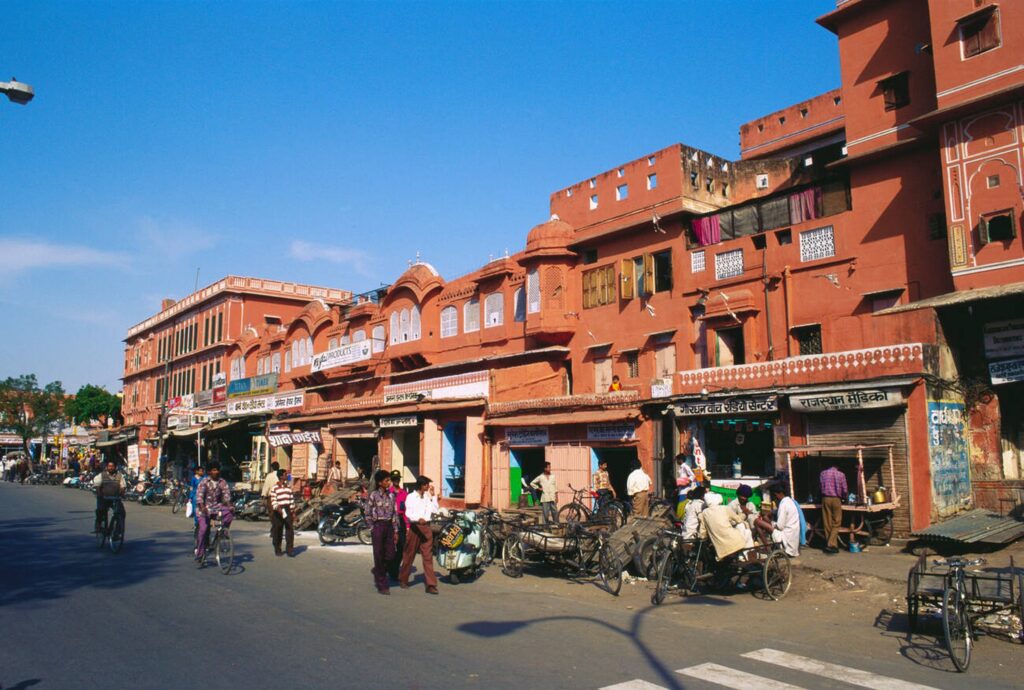
People who walk through Jaipur today might notice something strange: not all of the pink buildings are the same colour. The city’s famous colour stays the same, but there are some interesting changes and problems with keeping it that way.
How the Colour Stays the Same
The well-known law from 1877 that requires buildings in the Walled City to have pink facades is still in effect today. Many neighbourhoods in modern Jaipur still have different shades of pink, which keeps the city’s romantic atmosphere that continues to draw visitors. The pink walls, on the other hand, are always fighting pollution, which covers and erodes the historic sandstone and plaster with black dust. This means that restoration work must be done on a regular basis.
Rules from the government and local efforts
To protect Jaipur’s pink heritage, the government has strict rules about how buildings should look:
- Specific shade requirements: Buildings must use the real “Jaipur Pink” (hirmich, which is similar to brick red), not fake shades.
- Detailed color guidelines: White should be used for stencils, decorative details, painted borders, railings, and parapets. Light pink should be used for shop shutters, and dark brown should be used for wooden elements.
- Material restrictions: Facades can’t have metal sheets, reflective glass, ceramic tiles, or temporary structures on them.
Even though there are rules about this, the buildings in the Walled City have different shades of pink. It is hard for officials to enforce these standards because different departments are arguing over who is in charge. The government has also set aside ₹100 crore to protect this UNESCO World Heritage Site by preserving its architecture and improving its infrastructure.
Jaipur: More Than Pink
Jaipur has a lot more to offer than its famous pink walls. It has a lot of colours and experiences that many travellers miss. As you go deeper into the city, the colourful tapestry of Rajasthan’s culture reveals itself in surprising ways.
The Bright Gates of Jaipur
The walled city has seven beautiful gates, each with its own story. The Surajpole (Sun Gate) is on the east side, facing the rising sun, and the Chandpole (Moon Gate) is on the west side, facing the rising moon. The Zorawar Singh Gate, which was first built and is the widest, was originally called Dhruv Pole after the pole star. The newer Patrika Gate, built in 2016, continues Jaipur’s architectural legacy with its colourful hand-painted murals showing Rajasthani culture in nine pavilions.
Lively Local Bazaars
There is a lot of life in Jaipur’s markets. Johari Bazaar has beautiful Kundan and Meenakari jewellery, and Bapu Bazaar has Bandhani fabrics and leather goods made by hand. Lac bangles and metal crafts are what Tripolia Bazaar is known for. Nehru Bazaar has cheap, well-designed traditional juttis (footwear) that are perfect for you.
The mix of old and new in modern Jaipur
Jaipur today is a beautiful mix of old and new. Modern buildings like the Jaipur House by Nuar Studios use traditional materials like red sandstone jali screens in simple designs to make spaces that honour the past while looking to the future.
Top Places to See in the Pink City
People from all over the world come to Jaipur to see its many beautiful buildings. These five gems stand out among the city’s treasures as you walk through the streets that are a light brown colour.
Hawa Mahal: the Palace of Winds
First and foremost, this five-story building shaped like a honeycomb will take your breath away with its 953 small windows, which are called jharokhas. Maharaja Sawai Pratap Singh built this amazing building in 1799 so that royal women could watch street festivals without being seen. The palace’s smart design makes a cool breeze, which makes it a great place for the royal family to spend the summer.
City Palace: Royal Grandeur
This beautiful complex is in the centre of old Jaipur and is a perfect example of Mughal and Rajput architecture coming together. The City Palace is still home to the last royal family that ruled, and it also has the Maharaja Sawai Man Singh II Museum inside. Don’t miss the beautiful Mubarak Mahal, which has delicate white marble carvings, or the seven-story Chandra Mahal, which has amazing views.
Jantar Mantar: A Wonder of Astronomy
This UNESCO World Heritage Site, which has 19 architectural astronomical instruments, is only a few steps away. The Vrihat Samrat Yantra is the observatory’s most important piece. It is the world’s largest stone sundial and can tell time to within two seconds! These huge tools, which were made in 1734, let you see the positions of stars and planets with the naked eye.
Amber Fort: A Treasure of History
This beautiful fort-palace complex sits on top of a hill and has beautiful Hindu-Muslim architectural features. The beautiful courtyards, detailed mirror work, and stunning views of the Aravalli hills make for an unforgettable experience.
Shopping in the Pink Lanes: Johari and Bapu Bazaar
To really get a feel for Jaipur, you have to wander through these old markets:
Johari Bazaar: Shines with traditional Kundan and Meenakari jewellery that has precious stones in it
Bapu Bazaar: Full of colourful Bandhani dupattas, Bagru-printed kurtis, and traditional Rajasthani fabrics.
Best Time to Visit Jaipur
To plan your trip to Jaipur, you need to know how its weather is different from other places. The Pink City is in a semi-desert area, so the weather changes a lot from season to season. These changes can make or break your trip.
Winter Season (Nov–Feb)
Jaipur’s best weather is in the winter, when temperatures range from 8°C to 32°C. This golden time gives us:
- Nice days are great for seeing forts and palaces.
- Nice evenings are great for eating on the roof with a view of the city.
- There are a lot of fun cultural events, like the Jaipur Literature Festival in January.
In addition, the architecture of the Pink City looks best in the clear, bright light of winter. Accommodation prices are at their highest during this time because it is when the most tourists come.
Monsoon Season (Jul–Sep)
The monsoon in Jaipur is not as bad as it is in other parts of India. In July, the city gets about 137 mm of rain, and in August, it gets about 139 mm. As a result, you will feel:
- Temperatures range from 24°C to 34°C
- The pink buildings shone after the rain, making the landscapes look new.
- The Teej Festival is a colourful event with traditional parades.
The Pink City looks especially beautiful during these months, and monuments like Amber Fort are great for taking pictures.
Summer Season (Apr–Jun)
Jaipur summers are very hot, with temperatures often going over 40°C. But this off-season has some unique benefits:
- Much lower rates for places to stay
- Less tourists at big attractions
- The Elephant Festival takes place in March (early summer).
In the summer, early mornings and evenings are the best times to go sightseeing for a short time.
Tips for Travelling to Jaipur
To get around the beautiful Pink City, you need to know a few things. Here’s what you need to know to have an amazing time in Jaipur.
How to Get Around Jaipur
There are many ways to get around Jaipur that fit every budget:
- Auto rickshaws: are great for short trips, but always agree on the price ahead of time or insist on using the meter.
- Uber and Ola: offer rides all over the city that are easy to use and cheap.
- E-rickshaws: are great for getting around the old city’s narrow streets.
- Full-day vehicle hire: costs approximately 500 rupees for auto rickshaws or 1600 rupees for taxis
City buses connect major attractions for budget travellers, but they can get crowded during busy times.
Where to Stay to Get the Real Pink Experience
These neighbourhoods are great for a real experience:
- Pink City: (the old town) is great for people who love history because it’s easy to get to the main attractions.
- Sindhi Camp: A cheap place to stay with great street food options
- C-Scheme: A fancy neighbourhood with cool cafés and places to work together
- Bani Park: is a quieter neighbourhood with mid-range haveli options.
There are places to stay for everyone, from fancy palaces like Rambagh Palace to historic havelis like Samode Haveli.
How long you should stay
Most people who visit Jaipur think that two to three days is enough time to see the main sights. A three-day itinerary does let you see the city in depth without feeling rushed. If you want to see more than just the city centre, think about staying for five days.
Conclusion – Why Jaipur is Known as the Pink City
Jaipur is a real example of royal hospitality and cultural heritage. The city’s famous pink colour, which was first used to welcome Prince Albert Edward in 1876, has been its most important feature for almost 150 years. The terracotta-pink walls are still very popular with tourists from all over the world, even though the exact colour changes from place to place in the city.
Jaipur has a lot more to offer than just its famous colour. It has a rich history, beautiful architecture, and lively markets. The Hawa Mahal, the Jantar Mantar, and the City Palace all tell stories of a glorious past. The busy bazaars show off Rajasthan’s living traditions.
People who are going for the first time should plan their trip for the nice winter months from November to February. This timing lets you comfortably explore the Pink City while taking in its rich culture. The monsoon season, on the other hand, brings a new city with fewer tourists and its own special charm.
Last but not least, keep in mind that Jaipur rewards those who go off the beaten path. The local restaurants, colourful gates, and hidden courtyards are often the best places to get a real feel for the area. The Pink City promises memories painted in the warmest colours of hospitality, whether you spend three days seeing the sights or a week fully immersing yourself.
Get your bags ready to be welcomed by the city that painted an entire town pink just to say “you’re our honoured guest.”
FAQ’s
1. Why is Jaipur known as the Pink City?
In 1876, Maharaja Sawai Ram Singh II ordered the whole city to be painted pink to welcome Prince Albert Edward. That’s how Jaipur got the nickname “Pink City.” In Rajasthani culture, the colour terracotta pink stands for hospitality.
Q2. Is Jaipur still pink?
Jaipur is still pink, but the exact shade of pink varies from building to building. A law from 1877 says that buildings in the old city must be painted pink, and the government is still working to protect this special heritage.
Q3. What are the best places to see in Jaipur?
The Hawa Mahal (Palace of Winds), the City Palace, the Jantar Mantar observatory, lively markets like Johari and Bapu, and the beautiful Amber Fort are some of the best things to see in Jaipur.
Q4. What time of year is best to go to Jaipur?
The best time to go to Jaipur is in the winter, from November to February, when the weather is mild and good for sightseeing. The landscape looks new again during the monsoon season (July to September), but it can be very hot during the summer (April to June).
Q5. What is the best way for tourists to enjoy Jaipur’s pink charm?
Stay in the old city area of Jaipur to really enjoy its pink charm. Walk or take an e-rickshaw around the city, and go during the golden hours of sunrise or sunset to see the pink buildings at their best. Don’t forget to check out the colourful markets that go along with the city’s rosy colour.

1 Comment
A WordPress Commenter
September 2, 2026 at 7:48 pmThe practical implications are interesting from an investor’s perspective.
Calculadora de pago anticipado de préstamo – Ahorros por pagos adicionales